Advanced Methods
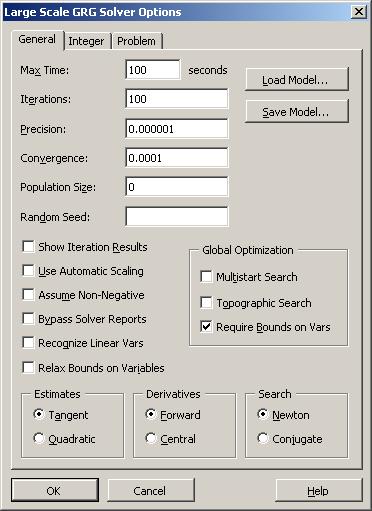
The Large-Scale GRG Solver can use Premium Solver Platform's "multistart" or "clustering" methods for global optimization. It can be automatically run many times from judiciously chosen starting points, and the best solution found will be returned as the optimal solution. For some smooth nonlinear problems, multistart methods will converge in probability to the globally optimal solution. For other problems, they often yield very good solutions in an acceptable amount of time -- and of course, they are far easier to use than a manual exploratory process. And you don't have to change your model at all to take advantage of these new global optimization capabilities! |
|
Sparse Matrix Storage
Sparse matrix storage methods take advantage of sparsity in large models, where subsets of the constraints typically depend on only a small subset of the variables.
For example, the Jacobian matrix (the matrix of partial derivatives of the objective and constraints with respect to the variables) for a problem with 2,000 variables and 2,000 constraints would take about 32 megabytes for matrix storage using dense storage methods, but if this problem has the sparsity typical of larger models, it would take as little as 1 to 1.5 megabytes using the sparse storage methods in the Large-Scale GRG Solver.
Improved Methods for Numerical Stability
Large nonlinear models require hundreds of thousands to millions of floating-point arithmetic calculations. Because of the finite precision inherent in computer arithmetic, small numerical errors occur in these calculations. Nonlinear models are particularly susceptible to the cumulative effect of these errors, which can lead to a numerically unstable or ill-conditioned matrix representation of the problem.The Large-Scale GRG Solver uses several advanced methods to deal with numerical stability, including methods for estimating the conditioning of the Jacobian and Hessian matrix, special methods for dealing with degeneracy, and advanced methods for selecting changes in the basis (which represents the currently binding constraints in the problem).
Thanks to these methods, the Large-Scale GRG Solver can find very good or optimal solutions to problems that could not be solved at all with more primitive nonlinear optimizers.
Options for Mixed-Integer Nonlinear Problems
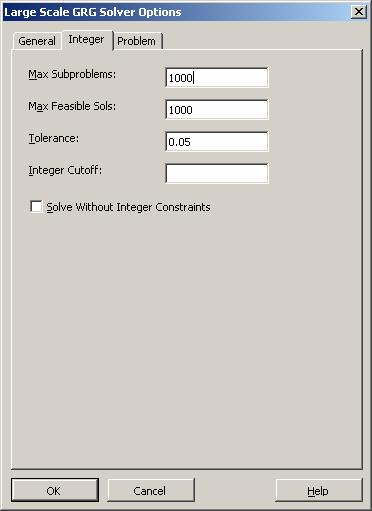
The Large-Scale GRG Solver uses the Premium Platform's Branch and Bound method to handle integer variables and "alldifferent" constraints. If your problem includes integer constraints, you can obtain a quick solution of the relaxation (temporarily ignoring the integer constraints) without having to delete these constraints and then re-enter them later. You can control the number of Branch and Bound subproblems and the number of integer feasible solutions found before the Solver stops. And you can speed up the solution of problems with integer constraints by supplying an integer cutoff value -- often known from a previous run. |
|