
We've just released Analytic Solver V2026 Q4, with new versions of Analytic Solver Desktop and Cloud (for Excel users), Solver SDK (for developers), and our cloud platform RASON. A highlight of this release -- in Analytic Solver -- is a new multi-purpose Solver Engine, based on the Hexaly Optimizer (their V15.0) from Hexaly Inc. Based on our extensive tests of this Solver on hundreds of models -- from linear mixed-integer to smooth nonlinear to non-smooth / arbitrary models -- we can say that it's our most versatile Solver ever, with excellent performance across the full spectrum of optimization models. We believe it will be a valuable enhancement for most Analytic Solver users. (Unfortunately at present for licensing reasons, we cannot offer the Hexaly Solver for RASON or Solver SDK.)
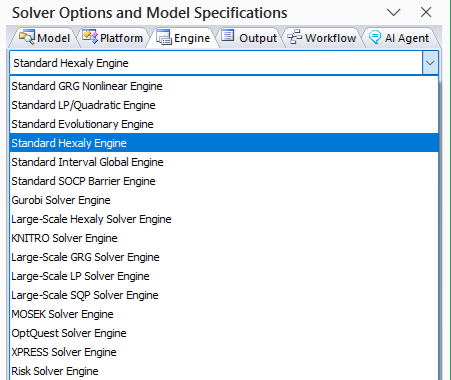
As you can see above, we're offering both a Standard Hexaly Solver built-in at no extra cost to Analytic Solver Optimization and Analytic Solver Comprehensive, and a Large-Scale Hexaly Solver Engine available at extra cost. The Standard version has the same size limits as other standard Solvers for the same problem types: 1,000 decision variables for nonlinear and non-smooth models, 8,000 variables for linear models. The Large-Scale version has no fixed limits other than available memory and compute time -- and our tests have shown that the Hexaly Solver is effective on very large linear, quadratic, nonlinear, and (reasonably structured) non-smooth models.
Background of the Hexaly Solver
The origins of the Hexaly Solver date back to 2010: it was developed by Thierry Benoist and Frédéric Gardi and first released as LocalSolver, since it used local search techniques for combinatorial optimization problems. Steadily enhanced over 16 years, it was renamed the Hexaly Solver in 2023. Hexaly's methods are quite different from the "branch & bound" search methods used in other Solvers, such as our LP/Quadratic and the Gurobi and Xpress Solvers, and also quite different from the "gradient-based search" methods used in our GRG and SQP and the Knitro Solver. They have a somewhat closer relationship to the search techniques in our Evolutionary and the OptQuest Solver, but are still quite different. One consequence of the Hexaly Solver's approach is that it -- unlike other Solvers -- can (very often, though not always) perform surprisingly well on the full range of models, from traditional "linear mixed-integer" models to "arbitrary" models using IF, CHOOSE, LOOKUP and similar Excel functions.
Hexaly + PSI Interpreter: A Potent Combination
The Hexaly Solver can work with models where the calculations represent a "black box" to the optimizer, but it is far more effective when the model's calculations can be presented to the optimizer in an internal form that "Hexaly understands". Analytic Solver can do this for a very wide range of Excel models, thanks to our Polymorphic Spreadsheet Interpreter (PSI). The PSI Interpreter understands how to calculate nearly all of Excel's ~500 built-in functions; it interprets functions such as STDEV as the "square root of the sum of the squares", and functions such as IF, CHOOSE, LOOKUP and more that "break the rules" of linear and smooth nonlinear models. In developing Analytic Solver V2026 Q4, we've extended the PSI Interpreter in a variety of ways to more effectively "convert models" to the form the Hexaly Solver understands. For nonlinear models, the PSI Interpreter also does this work for the Gurobi Solver. The difference can mean 100X faster solutions, as well as more accurate solutions.
For many of our customers who are more conversant with Excel (and its rich function library) than with the mathematical forms of linear, convex quadratic, smooth nonlinear, and non-smooth functions, the Hexaly Solver offers a new kind of "ease of use": While it's still a good idea to express the relationships in your model in linear or smooth nonlinear form -- when that's the physical reality -- it's now easier to get very good solutions with very good performance when those relationships involve conditionals or table lookups. There are some tradeoffs: For example, you won't be able to produce a Sensitivity Report -- with "reduced costs" and "shadow prices" -- for models solved with the Hexaly Solver. Often though not always, the Hexaly Solver finds and reports a "proven optimal" solution (especially when our PSI Interpreter can fully convert the model to a form Hexaly understands) ... but in our testing, it returns very good solutions even when it cannot "prove optimality".
Using Multiple Solvers on a Single Model
Many of our users don't think of this, but it is certainly possible to use more than one Solver on the same optimization model. This is a good idea in any case, to see comparative performance. But with the Hexaly Solver, there's an extra reason to use this approach: Since it doesn't always return a proof of optimality, it can be useful to first run the Hexaly Solver to obtain a very good solution, then run a different Solver Engine to see if it can improve on that solution and/or give a proof of optimality. (Most of our Solvers will use the final values of the decision variables as a starting point or "incumbent solution" in their own search, so they will spend less -- often far less -- time searching the feasible region, compared to "starting from scratch" with that Solver.)
There's More Coming -- But This is a Real Advance
As always at Frontline Systems, we're continuing to innovate and enhance Analytic Solver and RASON with new capabilities. You'll soon see a new release beyond V2026 Q4, with features such as multiple probability distributions in a single formula cell and support for the Gurobi Solver V14.0 (in beta test as we write this). But we believe that this Analytic Solver release is a real advance for many of our customers in their current use cases. We strongly encourage you to download and run the latest SolverSetup program to install Analytic Solver Desktop, and/or use the always-latest release of Analytic Solver Cloud, and try out the Hexaly Solver on your own models. And please let us know (support@solver.com) about your experience!